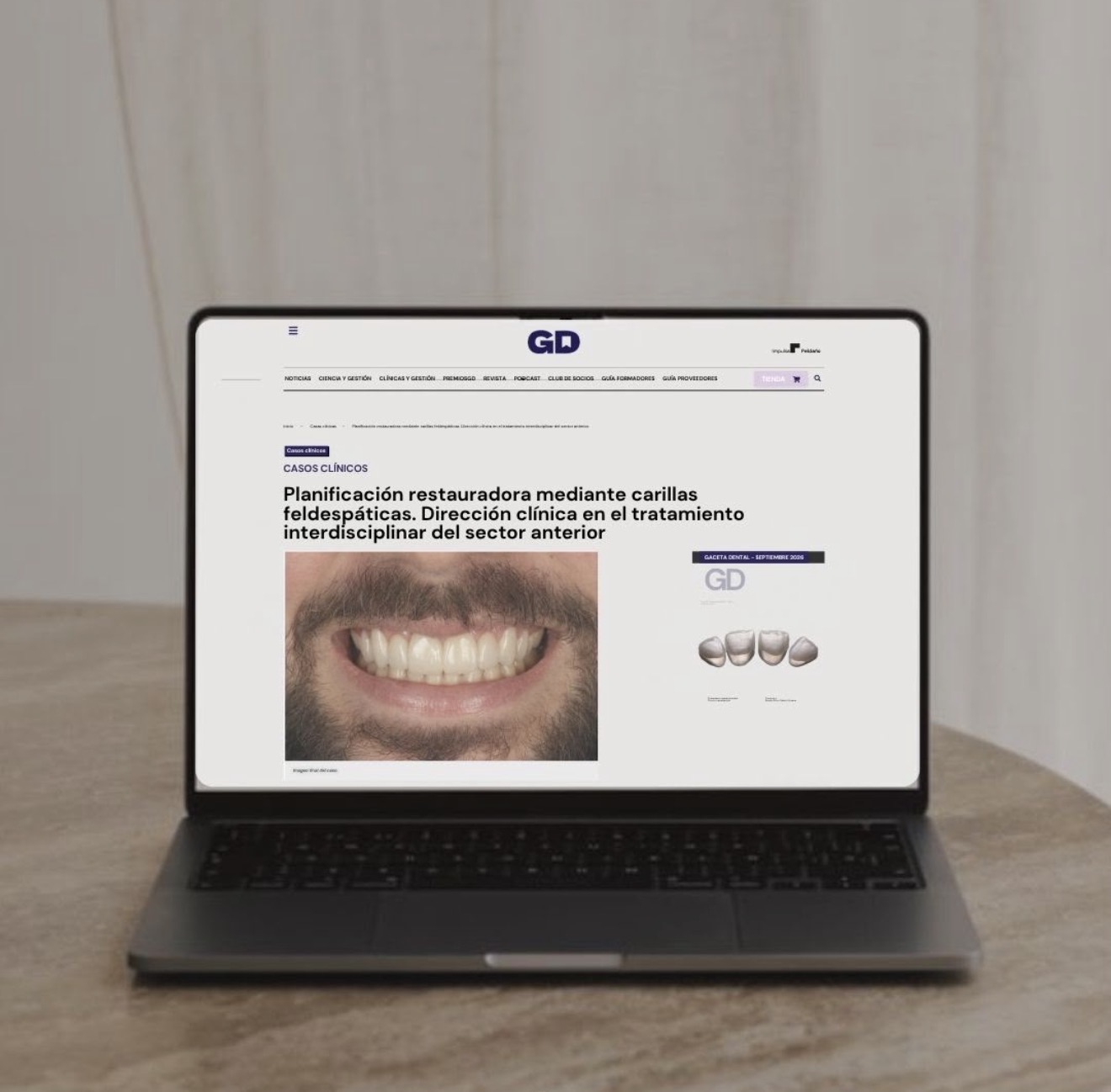
A few days ago, Gaceta Dental, one of the leading specialized publications in the dental sector, published a new article by Dr. Cristina Gras focusing on restorative planning using feldspathic veneers and clinical management in interdisciplinary treatments of the anterior region.
A clinical case that allows us to delve into one of the fundamental principles of our approach to dentistry: the final result must be planned long before reaching the definitive restoration.
When the restoration guides the treatment
In certain cases, improving a smile requires the intervention of different disciplines.
Orthodontics, periodontics, and restorative dentistry can all be part of the same treatment, but their true value emerges when they all work from a shared plan.
In the case presented by Dr. Gras, the final restoration is not approached as an independent final phase, but as the objective that allows for the prior definition of tooth position, gingival architecture, and the necessary restorative space.
In other words: first, we determine where we want to go, and then we establish the clinical path to achieve it.
Why is this planning important?
Because it allows for more precise and, especially, more conservative decisions.
Modifying a tooth position beforehand, working on gingival tissues when indicated, or determining the exact space required for future restorations can avoid subsequent compensations and help preserve a greater amount of healthy tooth structure.
Aesthetics thus ceases to be the only goal.
Function, biology, proportion, and naturalness must all be part of the same plan.
Feldspathic veneers as the final phase
Once the right conditions are established, feldspathic veneers allow for ultra-thin restorations with optical properties that blend naturally with the rest of the smile.
But one of the key takeaways from this case is that the success of veneers does not begin with the ceramic.
It begins much earlier: with the diagnosis, the planning, and the coordination of every discipline involved.
A way of understanding dentistry
The case published in Gaceta Dental also reflects the philosophy upon which GRAS® Methodis built: observing the case as a whole before intervening and establishing an individualized treatment sequence for each patient.
It is not about applying the same procedure to every smile, but about understanding what each one needs and the order in which we must act.
Diagnose. Plan. Preserve. Restore.
A form of dentistry where every decision is driven by the desired outcome, as well as respect for the existing tooth structure.
Read the full article
To delve deeper into the clinical case, interdisciplinary planning, and restorative protocol, you can view Dr. Cristina Gras's full publication in Gaceta Dental.
https://gacetadental.com/2026/09/planificacion-restauradora-mediante-carillas-feldespaticas/?utm_source=chatgpt.com